
Four Discourses of the Buddha on Everyman's Ethics
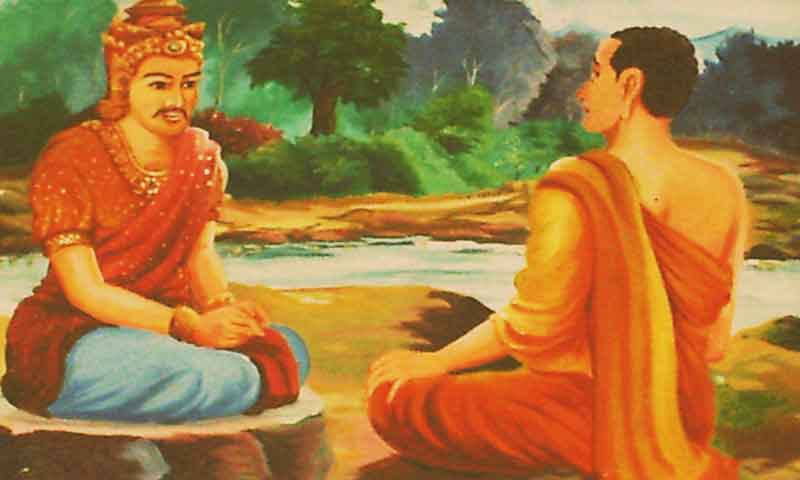
Four Discourses of the Buddha Adapted from the translations of Narada Thera
Contents
![[go to top]](../../images/scrollup.gif)
- Sigalovada Sutta: The Layman's Code of Discipline (Digha Nikaya, No. 31)
- Maha-mangala Sutta: Blessings (Sutta Nipata, vv. 258-269)
- Parabhava Sutta: Downfall (Sutta Nipata, vv. 91-115)
- Vyagghapajja Sutta: Conditions of Welfare (Anguttara Nikaya, Atthaka-nipata, No. 54)
These translations are adapted from the translations and notes in The Light of the Dhamma by the Venerable Narada Thera. The introductory notes to the last three texts have been supplied by the editor of this series.
Sigalovada Sutta
The Layman's Code of Discipline
Sigala was the son of a Buddhist family residing at Rajagaha. His parents were devout followers of the Buddha, but the son was indifferent to religion. The pious father and mother could not by any means persuade their son to accompany them to visit the Buddha or his disciples and hear the noble Doctrine. The son thought it practically useless to pay visits to the Sangha, as such visits may entail material loss. He was only concerned with material prosperity; to him spiritual progress was to no avail. Constantly he would say to his father: "I will have nothing to do with monks. Paying homage to them would make my back ache, and my knees stiff. I should have to sit on the ground and soil and wear out my clothes. And when, at the conversations with them, after so sitting, one gets to know them, one has to invite them and give them offerings, and so one only loses by it."
Finally as the father was about to die, he called his son to his deathbed, and enquired whether he would at least listen to his parting advice. "Most assuredly, dear father, I shall carry out any order you may be pleased to enjoin on me," he replied. "Well then, dear son, after your morning bath worship the six quarters." The father asked him to do so hoping that one day or other, while the son was so engaged, the Buddha or his disciples would see him, and make it an occasion to preach an appropriate discourse to him. And since deathbed wishes are to be remembered, Sigala carried out his father's wish, not, however, knowing its true significance.
Now it was the custom of the Buddha to rise from his sleep at four o'clock and after experiencing Nibbanic Bliss for an hour to pervade the whole world with his boundless thoughts of loving-kindness. It is at this hour that he surveys the world with his great compassion to find out what fellow being he could be of service on that day. One morning Sigala was caught in the net of the Buddha's compassion; and with his vision the Buddha, seeing that Sigala could be shown a better channel for his acts of worship, decided: "This day will I discourse to Sigala on the layman's Vinaya (code of discipline). That discourse will be of benefit to many folk. There must I go." The Buddha thereon came up to him on his way for alms to Rajagaha; and seeing him engaged in his worship of the six quarters, delivered this great discourse which contains in brief, the whole domestic and social duty of the layman.
Commenting on this Sutta, the Venerable Buddhaghosa says, "Nothing in the duties of a householder is left unmentioned. This Sutta is called the Vinaya of the householder. Hence in one who practices what he has been taught in it, growth is to be looked for, not decay." And Mrs. Rhys Davids adds: "The Buddha's doctrine of love and goodwill between man and man is here set forth in a domestic and social ethics with more comprehensive detail than elsewhere. And truly we may say even now of this Vinaya or code of discipline, so fundamental are the human interests involved, so sane and wide is the wisdom that envisages them, that the utterances are as fresh and practically as binding today and here as they were then at Rajagaha. 'Happy would have been the village or clan on the banks of the Ganges where the people were full of the kindly spirit of fellow-feeling, the noble spirit of justice which breathes through these naive and simple sayings.' Not less happy would be the village, or the family on the banks of the Thames today, of which this could be said."
Thus have I heard:
On one occasion the Exalted One was dwelling in the Bamboo Grove, the Squirrels' Sanctuary, near Rajagaha.
Now at that time, young Sigala, a householder's son, rising early in the morning, departing from Rajagaha, with wet clothes and wet hair, worshipped with joined hands the various quarters — the East, the South, the West, the North, the Nadir, and the Zenith.
Then the Exalted One, having robed himself in the forenoon took bowl and robe, and entered Rajagaha for alms. Now he saw young Sigala worshipping thus and spoke to him as follows:
"Wherefore do you, young householder, rising early in the morning, departing from Rajagaha, with wet clothes and wet hair, worship, with joined hands these various quarters — the East, the South, the West, the North, the Nadir, and the Zenith?"
"My father, Lord, while dying, said to me: The six quarters, dear son, you shall worship. And I, Lord, respecting, revering, reverencing and honoring my father's word, rise early in the morning, and leaving Rajagaha, with wet clothes and wet hair, worship with joined hands, these six quarters."
"It is not thus, young householder, the six quarters should be worshipped in the discipline of the noble."
"How then, Lord, should the six quarters be worshipped in the discipline of the noble? It is well, Lord, if the Exalted One would teach the doctrine to me showing how the six quarters should be worshipped in the discipline of the noble."
"Well, young householder, listen and bear it well in mind; I shall speak." — "Very good, Lord," responded young Sigala.
And the Exalted One spoke as follows:
"Inasmuch, young householder, as the noble disciple (1) has eradicated the four vices in conduct,1 (2) inasmuch as he commits no evil action in four ways, (3) inasmuch as he pursues not the six channels for dissipating wealth, he thus, avoiding these fourteen evil things, covers the six quarters, and enters the path leading to victory in both worlds: he is favored in this world and in the world beyond. Upon the dissolution of the body, after death, he is born in a happy heavenly realm.
(1) "What are the four vices in conduct that he has eradicated? The destruction of life, householder, is a vice and so are stealing, sexual misconduct, and lying. These are the four vices that he has eradicated."
Thus spoke the Exalted One. And when the Master had thus spoken, he spoke yet again:
Killing, stealing, lying and adultery,
These four evils the
wise never praise.
(2) "In which four ways does one commit no evil action? Led by desire does one commit evil. Led by anger does one commit evil. Led by ignorance does one commit evil. Led by fear does one commit evil.2
"But inasmuch as the noble disciple is not led by desire, anger, ignorance, and fear, he commits no evil."
Thus spoke the Exalted One. And when the Master had thus spoken, he spoke yet again:
Whoever through desire, hate or fear,
Or ignorance should
transgress the Dhamma,
All his glory fades away
Like the moon
during the waning half.
Whoever through desire, hate or fear,
Or ignorance never transgresses the Dhamma,
All his glory ever
increases
Like the moon during the waxing half.
(3) "What are the six channels for dissipating wealth which he does not pursue?
(a) "indulgence in intoxicants which cause infatuation and heedlessness;
(b) sauntering in streets at unseemly hours;
(c) frequenting
theatrical shows;
(d) indulgence in gambling which causes heedlessness;
(e) association with evil companions;
(f) the habit of idleness.
(a) "There are, young householder, these six evil consequences in indulging in intoxicants which cause infatuation and heedlessness:
(i) loss of wealth,
(ii) increase of quarrels,
(iii) susceptibility
to disease,
(iv) earning an evil reputation,
(v) shameless
exposure of body,
(vi) weakening of intellect.
(b) "There are, young householder, these six evil consequences in sauntering in streets at unseemly hours:
(i) he himself is unprotected and unguarded,
(ii) his wife
and children are unprotected and unguarded,
(iii) his property
is unprotected and unguarded,
(iv) he is suspected of evil deeds,3
(v) he is subject to false rumours,
(vi) he meets with many troubles.
(c) "There are, young householder, these six evil consequences in frequenting theatrical shows. He is ever thinking:
(i) where is there dancing?
(ii) where is there singing?
(iii) where is there music?
(iv) where is there recitation?
(v) where is there playing with cymbals?
(vi) where is there
pot-blowing?4
(d) "There are, young householder, these six evil consequences in indulging in gambling:
(i) the winner begets hate,
(ii) the loser grieves for lost
wealth,
(iii) loss of wealth,
(iv) his word is not relied
upon in a court of law,
(v) he is despised by his friends and
associates,
(vi) he is not sought after for matrimony; for people
would say he is a gambler and is not fit to look after a wife.
(e) "There are, young householder, these six evil consequences in associating with evil companions, namely: any gambler, any libertine, any drunkard, any swindler, any cheat, any rowdy is his friend and companion.
(f) "There are, young householder, these six evil consequences in being addicted to idleness:
"He does no work, saying:
(i) that it is extremely cold,
(ii) that it is extremely hot,
(iii) that it is too late in the evening,
(iv) that it is too
early in the morning,
(v) that he is extremely hungry,
(vi)
that he is too full.
"Living in this way, he leaves many duties undone, new wealth he does not get, and wealth he has acquired dwindles away."
Thus spoke the Exalted One. And when the Master had thus spoken, he spoke yet again:
"One is a bottle friend; one says, 'friend, friend' only to one's face; one is a friend and an associate only when it is advantageous.
"Sleeping till sunrise, adultery, irascibility, malevolence, evil companions, avarice — these six causes ruin a man.
"The man who has evil comrades and friends is given to evil ways, to ruin does he fall in both worlds — here and the next.
"Dice, women, liquor, dancing, singing, sleeping by day, sauntering at unseemly hours, evil companions, avarice — these nine5 causes ruin a man.
"Who plays with dice and drinks intoxicants, goes to women who are dear unto others as their own lives, associates with the mean and not with elders — he declines just as the moon during the waning half.
"Who is drunk, poor, destitute, still thirsty whilst drinking, frequents the bars, sinks in debt as a stone in water, swiftly brings disrepute to his family.
"Who by habit sleeps by day, and keeps late hours, is ever intoxicated, and is licentious, is not fit to lead a household life.
"Who says it is too hot, too cold, too late, and leaves things undone, the opportunities for good go past such men.
"But he who does not regard cold or heat any more than a blade
of grass and who does his duties manfully, does not fall away from
happiness."
"These four, young householder, should be understood
as foes in the guise of friends:
(1) he who appropriates a friend's possessions,
(2) he who
renders lip-service,
(3) he who flatters,
(4) he who brings
ruin.
(1) "In four ways, young householder, should one who appropriates be understood as a foe in the guise of a friend:
(i) he appropriates his friend's wealth,
(ii) he gives little
and asks much,
(iii) he does his duty out of fear,
(iv) he
associates for his own advantage.
(2) "In four ways, young householder, should one who renders lip-service be understood as a foe in the guise of a friend:
(i) he makes friendly profession as regards the past,
(ii)
he makes friendly profession as regards the future,
(iii) he
tries to gain one's favor by empty words,
(iv) when opportunity
for service has arisen, he expresses his inability.
(3) "In four ways, young householder, should one who flatters be understood as a foe in the guise of a friend:
(i) he approves of his friend's evil deeds,
(ii) he disapproves
his friend's good deeds,
(iii) he praises him in his presence,
(iv) he speaks ill of him in his absence.
(4) "In four ways, young householder, should one who brings ruin be understood as a foe in the guise of a friend:
(i) he is a companion in indulging in intoxicants that cause
infatuation and heedlessness,
(ii) he is a companion in sauntering
in streets at unseemly hours,
(iii) he is a companion in frequenting
theatrical shows,
(iv) he is a companion in indulging in gambling
which causes heedlessness."
Thus spoke the Exalted One. And when the Master had thus spoken, he spoke yet again:
The friend who appropriates,
the friend who renders lip-service,
the friend that flatters,
the friend who brings ruin,
these
four as enemies the wise behold,
avoid them from afar as paths
of peril.
"These four, young householder, should be understood as warm-hearted friends:
(1) he who is a helpmate,
(2) he who is the same in happiness
and sorrow,
(3) he who gives good counsel,
(4) he who sympathises.
(1) "In four ways, young householder, should a helpmate be understood as a warm-hearted friend:
(i) he guards the heedless,
(ii) he protects the wealth of
the heedless,
(iii) he becomes a refuge when you are in danger,
(iv) when there are commitments he provides you with double the
supply needed.
(2) "In four ways, young householder, should one who is the same in happiness and sorrow be understood as a warm-hearted friend:
(i) he reveals his secrets,
(ii) he conceals one's own secrets,
(iii) in misfortune he does not forsake one,
(iv) his life even
he sacrifices for one's sake.
(3) "In four ways, young householder, should one who gives good counsel be understood as a warm-hearted friend:
(i) he restrains one from doing evil,
(ii) he encourages one
to do good,
(iii) he informs one of what is unknown to oneself,
(iv) he points out the path to heaven.
(4) "In four ways, young householder, should one who sympathises be understood as a warm-hearted friend:
(i) he does not rejoice in one's misfortune,
(ii) he rejoices
in one's prosperity,
(iii) he restrains others speaking ill of
oneself,
(iv) he praises those who speak well of oneself."
Thus spoke the Exalted One. And when the Master had thus spoken, he spoke yet again:
The friend who is a helpmate,
the friend in happiness and
woe,
the friend who gives good counsel,
the friend who sympathises
too —
these four as friends the wise behold
and cherish them
devotedly
as does a mother her own child.
The wise and virtuous shine like a blazing fire.
He who acquires
his wealth in harmless ways
like to a bee that honey gathers,6
riches mount up for him
like ant hill's rapid growth.
With wealth acquired this way,
a layman fit for household
life,
in portions four divides his wealth:
thus will he friendship
win.
One portion for his wants he uses,7
two portions on his business
spends,
the fourth for times of need he keeps.
"And how, young householder, does a noble disciple cover the six quarters?
"The following should be looked upon as the six quarters. The parents should be looked upon as the East, teachers as the South, wife and children as the West, friends and associates as the North, servants and employees as the Nadir, ascetics and brahmans as the Zenith.8
"In five ways, young householder, a child should minister to his parents as the East:
(i) Having supported me I shall support them,
(ii) I shall
do their duties,
(iii) I shall keep the family tradition,
(iv) I shall make myself worthy of my inheritance,
(v) furthermore
I shall offer alms in honor of my departed
relatives.9
"In five ways, young householder, the parents thus ministered to as the East by their children, show their compassion:
(i) they restrain them from evil,
(ii) they encourage them
to do good,
(iii) they train them for a profession,
(iv) they
arrange a suitable marriage,
(v) at the proper time they hand
over their inheritance to them.
"In these five ways do children
minister to their parents as the East and the parents show their
compassion to their children. Thus is the East covered by them and
made safe and secure.
"In five ways, young householder, a pupil should minister to a teacher as the South:
(i) by rising from the seat in salutation,
(ii) by attending
on him,
(iii) by eagerness to learn,
(iv) by personal service,
(v) by respectful attention while receiving instructions.
"In five ways, young householder, do teachers thus ministered to as the South by their pupils, show their compassion:
(i) they train them in the best discipline,
(ii) they see
that they grasp their lessons well,
(iii) they instruct them
in the arts and sciences,
(iv) they introduce them to their friends
and associates,
(v) they provide for their safety in every quarter.
"The teachers thus ministered to as the South by their pupils, show their compassion towards them in these five ways. Thus is the South covered by them and made safe and secure.
"In five ways, young householder, should a wife as the West be ministered to by a husband:
(i) by being courteous to her,
(ii) by not despising her,
(iii) by being faithful to her,
(iv) by handing over authority
to her,
(v) by providing her with adornments.
"The wife thus ministered to as the West by her husband shows her compassion to her husband in five ways:
(i) she performs her duties well,
(ii) she is hospitable to
relations and attendants10
(iii) she is faithful,
(iv) she
protects what he brings,
(v) she is skilled and industrious in
discharging her duties.
"In these five ways does the wife show her compassion to her husband who ministers to her as the West. Thus is the West covered by him and made safe and secure.
"In five ways, young householder, should a clansman minister to his friends and associates as the North:
(i) by liberality,
(ii) by courteous speech,
(iii) by being
helpful,
(iv) by being impartial,
(v) by sincerity.
"The friends and associates thus ministered to as the North by a clansman show compassion to him in five ways:
(i) they protect him when he is heedless,
(ii) they protect
his property when he is heedless,
(iii) they become a refuge
when he is in danger,
(iv) they do not forsake him in his troubles,
(v) they show consideration for his family.
"The friends and associates thus ministered to as the North by a clansman show their compassion towards him in these five ways. Thus is the North covered by him and made safe and secure.
"In five ways should a master minister to his servants and employees as the Nadir:
(i) by assigning them work according to their ability,
(ii)
by supplying them with food and with wages,
(iii) by tending
them in sickness,
(iv) by sharing with them any delicacies,
(v) by granting them leave at times.
"The servants and employees thus ministered to as the Nadir by their master show their compassion to him in five ways:
(i) they rise before him,
(ii) they go to sleep after him,
(iii) they take only what is given,
(iv) they perform their duties
well,
(v) they uphold his good name and fame.
"The servants and employees thus ministered to as the Nadir show their compassion towards him in these five ways. Thus is the Nadir covered by him and made safe and secure.
"In five ways, young householder, should a householder minister to ascetics and brahmans as the Zenith:
(i) by lovable deeds,
(ii) by lovable words,
(iii) by lovable
thoughts,
(iv) by keeping open house to them,
(v) by supplying
their material needs.
"The ascetics and brahmans thus ministered to as the Zenith by a householder show their compassion towards him in six ways:
(i) they restrain him from evil,
(ii) they persuade him to
do good,
(iii) they love him with a kind heart,
(iv) they
make him hear what he has not heard,
(v) they clarify what he
has already heard,
(vi) they point out the path to a heavenly
state.
"In these six ways do ascetics and brahmans show their compassion towards a householder who ministers to them as the Zenith. Thus is the Zenith covered by him and made safe and secure." Thus spoke the Exalted One. And when the Master had thus spoken, he spoke yet again:
The mother and father are the East,
The Teachers are the South,
Wife and Children are the West,
The friends and associates are
the North.
Servants and employees are the Nadir,
The ascetics and brahmans
are the Zenith;
Who is fit to lead the household life,
These
six quarters he should salute.
Who is wise and virtuous,
Gentle and keen-witted,
Humble
and amenable,
Such a one to honor may attain.
Who is energetic and not indolent,
In misfortune unshaken,
Flawless in manner and intelligent,
Such a one to honor may attain.
Who is hospitable, and friendly,
Liberal and unselfish,
A guide, an instructor, a leader,
Such a one to honor may attain.
Generosity, sweet speech,
Helpfulness to others,
Impartiality
to all,
As the case demands.
These four winning ways make the world go round,
As the linchpin
in a moving car.
If these in the world exist not,
Neither
mother nor father will receive,
Respect and honor from their
children.
Since these four winning ways
The wise appraise in every way,
To eminence they attain,
And praise they rightly gain.
When
the Exalted One had spoken thus, Sigala, the young householder,
said as follows:
"Excellent, Lord, excellent! It is as if, Lord, a man were to set upright that which was overturned, or were to reveal that which was hidden, or were to point out the way to one who had gone astray, or were to hold a lamp amidst the darkness, so that those who have eyes may see. Even so, has the doctrine been explained in various ways by the Exalted One.
"I take refuge, Lord, in the Buddha, the Dhamma, and the Sangha. May the Exalted One receive me as a lay follower; as one who has taken refuge from this very day to life's end."
Notes
1. kamma-kilesa, lit., 'actions of defilement.'
2. These are the four agati, 'evil courses of action': chanda, dosa, moha, bhaya.
3. Crimes committed by others.
4. A kind of amusement.
5. The Pali original has here "six causes" as two compound words and one double-term phrase are counted as units.
6. Dhammapada v. 49: "As a bee, without harming the flower, its color or scent, flies away, collecting only the honey..."
7. This portion includes what is spent on good works: gifts to monks, charity, etc.
8. "The symbolism is deliberately chosen: as the day in the East, so life begins with parents' care; teacher's fees and the South are the same word: dakkhina; domestic cares follow when the youth becomes man, as the West holds the later daylight; North is 'beyond' (uttara), so by help of friends, etc., he gets beyond troubles." — (Rhys Davids)
9. This is a sacred custom of the Aryans who never forgot the dead. This tradition is still faithfully observed by the Buddhists of Sri Lanka who make ceremonial offerings of alms to the monks on the eighth day, in the third month, and on each anniversary of the demise of the parents. Merit of these good actions is offered to the departed after such ceremony. Moreover after every punna-kamma (good action), a Buddhist never fails to think of his parents and offer merit. Such is the loyalty and the gratitude shown to parents as advised by the Buddha.
10. lit., 'the folk around' (parijana).
Maha-mangala Sutta
Blessings1
This famous text, cherished highly in all Buddhist lands, is a terse but comprehensive summary of Buddhist ethics, individual and social. The thirty-eight blessings enumerated in it, are an unfailing guide on life's journey. Rightly starting with "avoidance of bad company" which is basic to all moral and spiritual progress, the Blessings culminate in the achievement of a passion-free mind, unshakable in its serenity. To follow the ideals set forth in these verses, is the sure way to harmony and progress for the individual as well as for society, nation and mankind.
"The Maha-mangala Sutta shows that the Buddha's instructions
do not always take negative forms, that they are not always a series
of classifications and analysis, or concerned exclusively with monastic
morality. Here in this sutta we find family morality expressed in
most elegant verses. We can imagine the happy blissful state household
life attained as a result of following these injunctions." (From
The Ethics of Buddhism by S. Tachibana, Colombo 1943, Bauddha Sahitya
Sabha).
Thus have I heard. On one occasion the Exalted One
was dwelling at Anathapindika's monastery, in Jeta's Grove,2 near
Savatthi.3 Now when the night was far spent, a certain deity whose
surpassing splendor illuminated the entire Jeta Grove, came to the
presence of the Exalted One and, drawing near, respectfully saluted
him and stood at one side. Standing thus, he addressed the Exalted
One in verse:
"Many deities and men, yearning after good, have pondered on
blessings.4 Pray, tell me the greatest blessing!"
[The Buddha:]
"Not to associate with the foolish,5 but to associate with the wise; and to honor those who are worthy of honor — this is the greatest blessing.
To reside in a suitable locality,6 to have done meritorious actions in the past and to set oneself in the right course7 — this is the greatest blessing.
To have much learning, to be skillful in handicraft,8 well-trained in discipline,9 and to be of good speech10 — this is the greatest blessing.
To support mother and father, to cherish wife and children, and to be engaged in peaceful occupation — this is the greatest blessing.
To be generous in giving, to be righteous in conduct,11 to help one's relatives, and to be blameless in action — this is the greatest blessing.
To loathe more evil and abstain from it, to refrain from intoxicants,12 and to be steadfast in virtue — this is the greatest blessing.
To be respectful,13 humble, contented and grateful; and to listen to the Dhamma on due occasions14 — this is the greatest blessing.
To be patient and obedient, to associate with monks and to have religious discussions on due occasions — this is the greatest blessing.
Self-restraint,15 a holy and chaste life, the perception of the Noble Truths and the realisation of Nibbana — this is the greatest blessing.
A mind unruffled by the vagaries of fortune,16 from sorrow freed, from defilements cleansed, from fear liberated17 — this is the greatest blessing.
Those who thus abide, ever remain invincible, in happiness established. These are the greatest blessings."18
Notes (Derived mainly from the Commentaries)
1. This Sutta appears in the Sutta-Nipata (v.258ff) and in the Khuddakapatha. See Maha-mangala Jataka (No. 453). For a detailed explanation see Life's Highest Blessing by Dr. R.L. Soni, WHEEL No. 254/256.
2. Anathapindika, lit., 'He who gives alms to the helpless'; his former name was Sudatta. After his conversion to Buddhism, he bought the grove belonging to the Prince Jeta, and established a monastery which was subsequently named Jetavana. It was in this monastery that the Buddha observed most of his vassana periods (rainy seasons — the three months' retreat beginning with the full-moon of July). Many are the discourses delivered and many are the incidents connected with the Buddha's life that happened at Jetavana. It was here that the Buddha ministered to the sick monk neglected by his companions, advising them: "Whoever, monks, would wait upon me, let him wait upon the sick." It was here that the Buddha so poignantly taught the law of impermanence, by asking the bereaved young woman Kisagotami who brought her dead child, to fetch a grain of mustard seed from a home where there has been no bereavement.
3. Identified with modern Sahet-Mahet, near Balrampur.
4. According to the Commentary, mangala means that which is conducive to happiness and prosperity.
5. This refers not only to the stupid and uncultured, but also includes the wicked in thought, word and deed.
6. Any place where monks, nuns and lay devotees continually reside; where pious folk are bent on the performance of the ten meritorious deeds, and where the Dhamma exists as a living principle.
7. Making the right resolve for abandoning immorality for morality, faithlessness for faith and selfishness for generosity.
8. The harmless crafts of the householder by which no living being is injured and nothing unrighteous done; and the crafts of the homeless monk, such as stitching the robes, etc.
9. Vinaya means discipline in thought, word and deed. The commentary speaks of two kinds of discipline — that of the householder, which is abstinence from the ten immoral actions (akusala-kammapatha), and that of the monk which is the non-transgression of the offences enumerated in the Patimokkha (the code of the monk's rules) or the 'fourfold moral purity' (catu-parisuddhi-sila).
10. Good speech that is opportune, truthful, friendly, profitable and spoken with thoughts of loving-kindness.
11. Righteous conduct is the observance of the ten good actions (kusala-kammapatha) in thought, word and deed: freeing the mind of greed, ill-will and wrong views; avoiding speech that is untruthful, slanderous, abusive and frivolous; and the non- committal acts of killing, stealing and sexual misconduct.
12. Total abstinence from alcohol and intoxicating drugs.
13. Towards monks (and of course also to the clergy of other religions), teachers, parents, elders, superiors, etc.
14. For instance, when one is harassed by evil thoughts.
15. Self-restraint (tapo): the suppression of lusts and hates by the control of the senses; and the suppression of indolence by the rousing of energy.
16. Loka-dhamma, i.e., conditions which are necessarily connected with life in this world; there are primarily eight of them: gain and loss, honor and dishonor, praise and blame, pain and joy.
17. Each of these three expressions refers to the mind of the arahant: asoka: sorrowless; viraja: stainless, i.e., free from lust, hatred and ignorance; khema: security from the bonds of sense desires (kama), repeated existence (bhava), false views (ditthi) and ignorance (avijja).
18. The above-mentioned thirty-eight blessings.
Parabhava Sutta:
Downfall
While the Mangala Sutta deals with the way of life conducive to progress and happiness, the Parabhava Sutta supplements it by pointing out the causes of downfall. He who allows himself to become tarnished by these blemishes of conduct blocks his own road to worldly, moral and spiritual progress and lowers all that is truly noble and human in man. But he who is heedful of these dangers keeps open the road to all those thirty-eight blessings of which human nature is capable.
Thus have I heard. Once the Exalted One was dwelling at Anathapindika's monastery, in the Jeta Grove, near Savatthi.
Now when the night was far spent a certain deity whose surpassing splendor illuminated the entire Jeta Grove, came to the presence of the Exalted One and, drawing near, respectfully saluted Him and stood at one side. Standing thus, he addressed the Exalted One in verse:
The Deity:
Having come here with our questions to the Exalted One, we ask thee, O Gotama, about man's decline. Pray, tell us the cause of downfall!
The Buddha:
Easily known is the progressive one, easily known he who declines. He who loves Dhamma progresses; he who is averse to it, declines.
The Deity:
Thus much do we see: this is the first cause of one's downfall. Pray, tell us the second cause.1
The Buddha:
The wicked are dear to him, with the virtuous he finds no delight, he prefers the creed of the wicked — this is a cause of one's downfall.
Being fond of sleep, fond of company, indolent, lazy and irritable — this is a cause of one's downfall.
Though being well-to-do, not to support father and mother who are old and past their youth — this is a cause of one's downfall.
To deceive by falsehood a brahman or ascetic or any other mendicant — this is a cause of one's downfall.
To have much wealth and ample gold and food, but to enjoy one's luxuries alone — this is a cause of one's downfall.
To be proud of birth, of wealth or clan, and to despise one's own kinsmen — this is a cause of one's downfall.
To be a rake, a drunkard, a gambler, and to squander all one earns — this is a cause of one's downfall.
Not to be contented with one's own wife, and to be seen with harlots and the wives of others — this is a cause of one's downfall.
Being past one's youth, to take a young wife and to be unable to sleep for jealousy of her — this is a cause of one's downfall.
To place in authority a woman given to drink and squandering, or a man of a like behavior — this is a cause of one's downfall.
To be of noble birth, with vast ambition and of slender means, and to crave for rulership — this is a cause of one's downfall.
Knowing well these causes of downfall in the world, the noble
sage endowed with insight shares a happy realm.
Note
1. These lines are repeated after each stanza, with the due enumeration.
Vyagghapajja Sutta:
Conditions of Welfare
In this sutta, the Buddha instructs rich householders how to preserve and increase their prosperity and how to avoid loss of wealth. Wealth alone, however, does not make a complete man nor a harmonious society. Possession of wealth all too often multiplies man's desires, and he is ever in the pursuit of amassing more wealth and power. This unrestrained craving, however, leaves him dissatisfied and stifles his inner growth. It creates conflict and disharmony in society through the resentment of the underprivileged who feel themselves exploited by the effects of unrestrained craving.
Therefore the Buddha follows up on his advice on material welfare with four essential conditions for spiritual welfare: confidence (in the Master's enlightenment), virtue, liberality and wisdom. These four will instill in man a sense of higher values. He will then not only pursue his own material concern, but also be aware of his duty towards society. To mention only one of the implications: a wisely and generously employed liberality will reduce tensions and conflicts in society. Thus the observing of these conditions of material and spiritual welfare will make for an ideal citizen in an ideal society.
Thus have I heard. Once the Exalted One was dwelling amongst the Koliyans,1 in their market town named Kakkarapatta. Then Dighajanu,2 a Koliyan, approached the Exalted One, respectfully saluted Him and sat on one side. Thus seated, he addressed the Exalted One as follows:
"We, Lord, are laymen who enjoy worldly pleasure. We lead a life encumbered by wife and children. We use sandalwood of Kasi. We deck ourselves with garlands, perfume and unguents. We use gold and silver. To those like us, O Lord, let the Exalted One preach the Dhamma, teach those things that lead to weal and happiness in this life and to weal and happiness in future life."
Conditions of Worldly Progress
"Four conditions, Vyagghapajja,3 conduce to a householder's weal and happiness in this very life. Which four?
"The accomplishment of persistent effort (utthana-sampada), the accomplishment of watchfulness (arakkha-sampada), good friendship (kalyanamittata) and balanced livelihood (sama-jivikata).
"What is the accomplishment of persistent effort?
"Herein, Vyagghapajja, by whatsoever activity a householder earns his living, whether by farming, by trading, by rearing cattle, by archery, by service under the king, or by any other kind of craft — at that he becomes skillful and is not lazy. He is endowed with the power of discernment as to the proper ways and means; he is able to carry out and allocate (duties). This is called the accomplishment of persistent effort.
"What is the accomplishment of watchfulness?
"Herein, Vyagghapajja, whatsoever wealth a householder is in possession of, obtained by dint of effort, collected by strength of arm, by the sweat of his brow, justly acquired by right means — such he husbands well by guarding and watching so that kings would not seize it, thieves would not steal it, fire would not burn it, water would not carry it away, nor ill-disposed heirs remove it. This is the accomplishment of watchfulness.
"What is good friendship?
"Herein, Vyagghapajja, in whatsoever village or market town a householder dwells, he associates, converses, engages in discussions with householders or householders' sons, whether young and highly cultured or old and highly cultured, full of faith (saddha),4 full of virtue (sila), full of charity (caga), full of wisdom (pañña). He acts in accordance with the faith of the faithful, with the virtue of the virtuous, with the charity of the charitable, with the wisdom of the wise. This is called good friendship.
"What is balanced livelihood?
"Herein, Vyagghapajja, a householder knowing his income and expenses leads a balanced life, neither extravagant nor miserly, knowing that thus his income will stand in excess of his expenses, but not his expenses in excess of his income.
"Just as the goldsmith,5 or an apprentice of his, knows, on holding up a balance, that by so much it has dipped down, by so much it has tilted up; even so a householder, knowing his income and expenses leads a balanced life, neither extravagant nor miserly, knowing that thus his income will stand in excess of his expenses, but not his expenses in excess of his income.
"If, Vyagghapajja, a householder with little income were to lead an extravagant life, there would be those who say — 'This person enjoys his property like one who eats wood-apple.'6 If, Vyagghapajja, a householder with a large income were to lead a wretched life, there would be those who say — 'This person will die like a starveling.'
"The wealth thus amassed, Vyagghapajja, has four sources of destruction:
"(i) Debauchery, (ii) drunkenness, (iii) gambling, (iv) friendship, companionship and intimacy with evil-doers.
"Just as in the case of a great tank with four inlets and outlets, if a man should close the inlets and open the outlets and there should be no adequate rainfall, decrease of water is to be expected in that tank, and not an increase; even so there are four sources for the destruction of amassed wealth — debauchery, drunkenness, gambling, and friendship, companionship and intimacy with evil-doers.
"There are four sources for the increase of amassed wealth: (i) abstinence from debauchery, (ii) abstinence from drunkenness, (iii) non-indulgence in gambling, (iv) friendship, companionship and intimacy with the good.
"Just as in the case of a great tank with four inlets and four outlets, if a person were to open the inlets and close the outlets, and there should also be adequate rainfall, an increase in water is certainly to be expected in that tank and not a decrease, even so these four conditions are the sources of increase of amassed wealth.
"These four conditions, Vyagghapajja, are conducive to a householder's weal and happiness in this very life.
Conditions of Spiritual Progress
"Four conditions, Vyagghapajja, conduce to a householder's weal and happiness in his future life. Which four?
"The accomplishment of faith (saddha-sampada), the accomplishment of virtue (sila-sampada), the accomplishment of charity (caga-sampada) and the accomplishment of wisdom (pañña-sampada).
"What is the accomplishment of faith?
"Herein a householder is possessed of faith, he believes in the Enlightenment of the Perfect One (Tathagata): Thus, indeed, is that Blessed One: he is the pure one, fully enlightened, endowed with knowledge and conduct, well-gone, the knower of worlds, the incomparable leader of men to be tamed, the teacher of gods and men, all-knowing and blessed. This is called the accomplishment of faith.
"What is the accomplishment of virtue?
"Herein a householder abstains from killing, stealing, sexual misconduct, lying, and from intoxicants that cause infatuation and heedlessness. This is called the accomplishment of virtue.
"What is the accomplishment of charity?
"Herein a householder dwells at home with heart free from the stain of avarice, devoted to charity, open-handed, delighting in generosity, attending to the needy, delighting in the distribution of alms. This is called the accomplishment of charity.
"What is the accomplishment of wisdom?
"Herein a householder is wise: he is endowed with wisdom that understands the arising and cessation (of the five aggregates of existence); he is possessed of the noble penetrating insight that leads to the destruction of suffering. This is called the accomplishment of wisdom.
"These four conditions, Vyagghapajja, conduce to a householder's weal and happiness in his future life."
Energetic and heedful in his tasks,
Wisely administering
his wealth,
He lives a balanced life,
Protecting what he has
amassed.
Endowed with faith and virtue too,
Generous he
is and free from avarice;
He ever works to clear the path
That leads to weal in future life.
Thus to the layman full of faith,
By him, so truly
named 'Enlightened,'
These eight conditions have been told
Which now and after lead to bliss.
Notes
1. The Koliyans were the rivals of the Sakyans. Queen Maha Maya belonged to the Koliyan clan and King Suddhodana to the Sakyan clan.
2. Literally, 'long-kneed'
3. 'Tiger's Path'; he was so called because his ancestors were born on a forest path infested with tigers. Vyagghapajja was Dighajanu's family name.
4. Saddha is not blind faith. It is confidence based on knowledge.
5. Tuladharo, lit., 'carrier of the scales.'
6. Udambarakhadaka. The Commentary explains that one who wishes to eat wood-apple shakes the tree, with the result that many fruits fall but only a few are eaten, while a large number are wasted.
Suggestions for Further Reading
- Buddhism - The Concept of Anatta or No Self
- Anatta or Anatma in Buddhism
- Anicca or Anitya in Buddhism
- The Buddha on God
- The Buddha on Avijja or Ignorance and on the Origin of Life
- The Eightfold Path Of Buddhism
- The Four Noble Truths of Buddhism
- Buddhism - Right Living On The Eightfold Path
- Handbook for the Relief of Suffering by Ajaan Lee
- Meat Eating or Vegetarianism in Buddhism
- The Agendas of Mindfulness
- Meditation on Anicca or Impermanence in Buddhism
- A Sketch of the Buddha's Life
- What is Ignorance And Cessation Of Ignorance
- The Meaning of the Buddha's Awakening
- Basic Breath Meditation Practice
- Buddha's Teachings on Kamma or Karma
- Affinities Of Buddhism And Christianity
- Death and Dying in Buddhism
- Buddhism In A Nutshell
- The Buddha on Ignorance or Avijja
- Dhamma for Everyone by Ajaan Lee Dhammadharo
- Advaita Vedanta and Buddhism
- Four Discourses of the Buddha on Everyman's Ethics
- The Five Aggregates A Study Guide
- The Healing Power of the Five Buddhist Percepts
- The Working of Maya or Illusion - A Buddhist Perspective
- Buddhism - Kamma (Karma) and its Fruit
- Buddhism - Kamma (Karma) A Study Guide
- Buddhism - Living the Dhamma A Practice Guide
- What Anatta or No-Self is All About
- Buddhism - The Middle Way
- The Buddhist Monastic Code, Dhamma-Vinaya
- Nibbana, or Nivranva in Buddhsim
- Why The Buddha Taught the Anatta or Not-Self Doctrine
- The Status of Women in Buddhist Societies
- Buddhism - The Practice of Loving-Kindness (Metta)
- Buddhism - Does Rebirth Make Sense
- Buddhism - Right Concentration
- Buddhism - Intentions and Nirvana
- The Round of Rebirth - Samsara
- The Role of Samavega in Buddhism
- The Chaos Theory and Nirvana in Buddhism
- A Christian's Journey Into Buddhism
- A Simple Guide to Buddhism
- Buddhist Cosmology - The Thirty one Realms of Existence
- Buddhism and the concept of renunciation
- Sankharas (Samskaras) in Buddhism
- Vedanta and Buddhism A Comparative Study
- Buddhism - Vipansana or Insight Meditation
- The Right Approach To End Suffering in Buddhismm
- Essays On Dharma
- Esoteric Mystic Hinduism
- Introduction to Hinduism
- Hindu Way of Life
- Essays On Karma
- Hindu Rites and Rituals
- The Origin of The Sanskrit Language
- Symbolism in Hinduism
- Essays on The Upanishads
- Concepts of Hinduism
- Essays on Atman
- Hindu Festivals
- Spiritual Practice
- Right Living
- Yoga of Sorrow
- Happiness
- Mental Health
- Concepts of Buddhism
- General Essays
Source: The Wheel Publication No. 14 (Kandy: Buddhist Publication Society, 1985). Transcribed from the print edition in 1995 by Barry Kapke under the auspices of the DharmaNet Dharma Book Transcription Project, with the kind permission of the Buddhist Publication Society.Copyright © 1985 Buddhist Publication Society. Reproduced and reformatted from Access to Insight edition © 1995 For free distribution. This work may be republished, reformatted, reprinted, and redistributed in any medium. It is the author's wish, however, that any such republication and redistribution be made available to the public on a free and unrestricted basis and that translations and other derivative works be clearly marked as such.